
Starting July 1, 2026, a truck toll will be introduced in the Netherlands. Trucks will pay for every kilometer driven, making road transport structurally more expensive. For container transport, this will primarily affect regular routes to and from seaports: routes that currently rely too heavily on road transport.
For planners and freight forwarders, this means that existing container flows must be reassessed. How will this toll affect the cost per round trip? Which corridors will become more susceptible to delays and rising costs? And where will there be opportunities to organize container transport more efficiently? Certainly in the eastern Netherlands and the Achterhoek region, where the distance to the port is greater, the truck toll
In this article, we’ll show what this means in practice for daily container planning and when alternatives like inland waterway transport actually become viable options.
What does the truck toll entail?
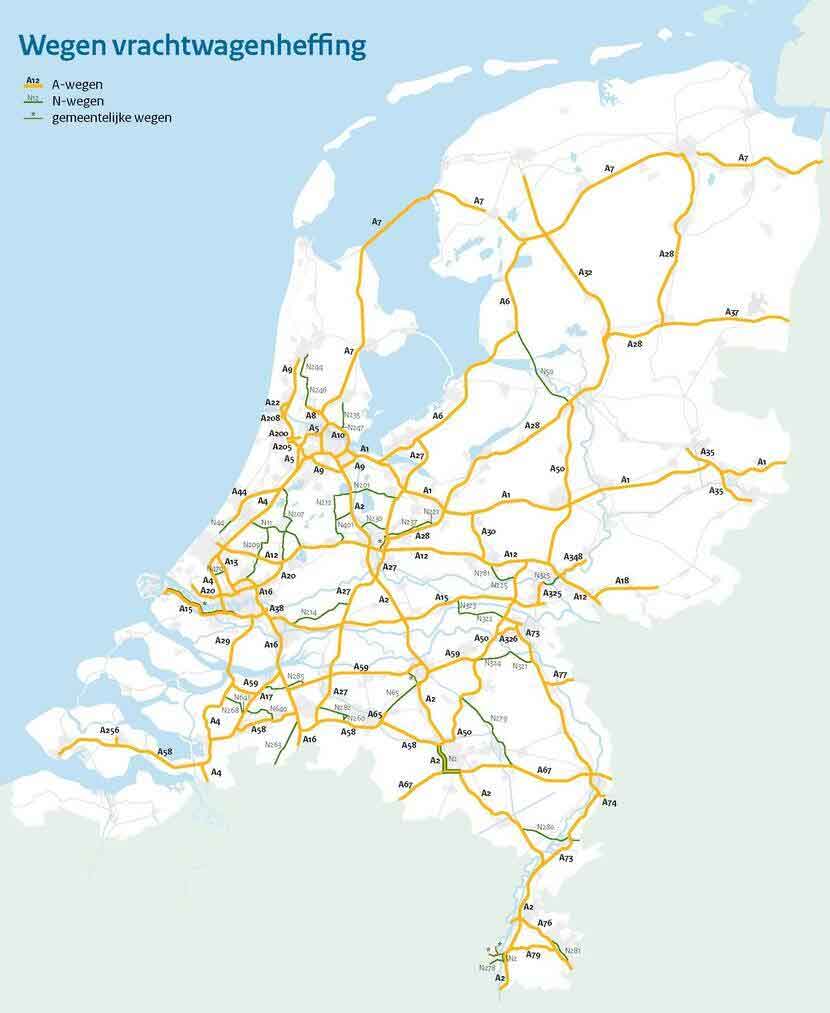
The truck toll is a charge per kilometer driven for trucks and will take effect on July 1, 2026. The measure applies to both domestic and foreign trucks on the Dutch road network and is intended to make road usage pricing fairer and to encourage more sustainable transport.
The amount of the charge depends on factors such as kilometers driven, vehicle type, and emission class. Exact rates vary by situation, but one principle is certain: every additional kilometer driven has a direct cost impact. The real consequence, therefore, lies not in the rule itself, but in what this means for container transport on a per-trip basis.
What does the truck toll mean for container transport?
The truck toll has a greater impact on container transport than on occasional road transport. Containers are often transported via fixed corridors and on repetitive trips between inland terminals, distribution centers, and seaports. It is precisely this repetition that causes a per-kilometer toll to add up quickly.
Because the toll applies per trip and per return trip, costs pile up with regular shuttle runs. In a market with relatively thin margins, every additional cost is immediately felt per container. On top of that, road transport is sensitive to congestion and wait times: detours or delays automatically mean extra kilometers and thus extra tolls, without adding any value.
As a result, the focus in planning is shifting from speed alone to reliability and predictability. This is precisely where the truck toll becomes a new factor in the trade-off between road transport and alternatives.
What does this mean for the Eastern Netherlands and the Achterhoek?
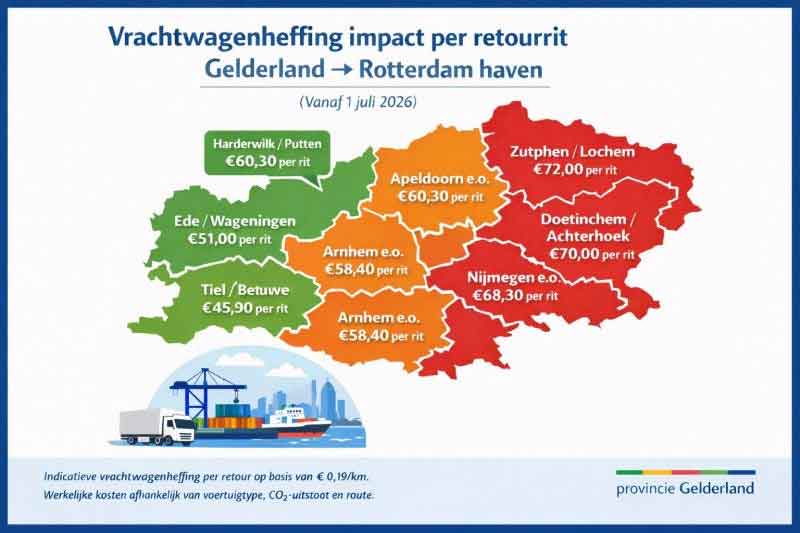
Data from the province of Gelderland shows that the truck toll per round trip can vary depending on the route. For routes to Rotterdam, for example, every container movement becomes structurally more expensive, regardless of extra kilometers caused by traffic jams or detours. With fixed container flows, these costs add up quickly.
Regions farther from the seaports are therefore hit relatively harder than logistics hubs in the Randstad. For companies in the eastern Netherlands, the truck toll could thus become a decisive factor in the organization of their container transport.
When does inland waterway transport become an attractive alternative?
The truck toll primarily changes the calculation for recurring container flows and fixed corridors. Inland waterway transport becomes more attractive when volumes are consistent and routes lend themselves to a combination of water and short road connections, such as in the Rotterdam–Eastern Netherlands–Ruhr region corridor. In such situations, a portion of the road mileage can be replaced, which limits the cost impact and makes planning more predictable.
At the same time, inland waterway transport is not a solution for every container movement. For occasional shipments, small volumes, or highly time-sensitive transport, road transport often remains necessary. Inland waterway transport primarily adds value as a targeted component of a multimodal chain—a deliberate choice within a changing cost structure.
Corridor thinking: from road kilometers to smart combinations
Corridor thinking isn’t about which mode of transport is better, but about how modes complement each other. Instead of transporting a container entirely by road, we look at where road transport makes sense and where alternatives are a better fit. This creates a practical modal shift: long distances by water, short stretches by road.
A common combination is seaport → inland waterway → short road connection to the final destination. This allows a large portion of the journey to be completed outside the congested road network. The benefit lies not only in lower costs due to reduced truck tolls, but also in reduced dependence on daily traffic congestion and more stable scheduling. Indicative cost comparisons and example scenarios for container transport show that it is precisely these smart combinations that make the difference when road mileage becomes structurally more expensive.
What can logistics planners do right now?
Although the truck toll won’t take effect until July 2026, it’s already important to start preparing now. By gaining insight into the route structure and fixed corridors, it becomes clear where road mileage is accumulating and which container flows are vulnerable to structural cost increases.
The truck toll thus acts as a catalyst for smarter transport. Not by immediately replacing existing solutions, but by incorporating alternatives into planning early on and engaging in discussions about multimodal options. Container Terminal Doesburg is happy to assist as a knowledge partner: contributing ideas on container flows, corridors, and transport modes, so that planners can adapt their network step by step to a changing logistics landscape. Please feel free to contact us for more information.
Frequently asked questions about truck tolls and container transport
Does the truck toll also apply to container transport?
Does the truck toll automatically make container transport more expensive?
In many cases, yes, because truck transport is typically taxed via the kilometer toll. This can increase costs, especially over longer distances. At the same time, there are situations where total logistics costs do not necessarily rise, for example due to more efficient routes, consolidation of volumes, or a shift to other modes of transport.
Is inland waterway transport always cheaper than road transport?
In general, inland waterway transport is cheaper than road transport. Although inland waterway transport is often more cost-efficient for large volumes and fixed, recurring flows, the choice depends heavily on factors such as volume, distance, corridor, and planning flexibility.
What does the truck toll mean for existing transport contracts?
That varies by contract and term. In many cases, the truck toll will be passed on in rates.
What is the difference between a road toll and a truck toll?
A truck toll is a road toll specifically for trucks. Passenger cars are not subject to this; in the context of transportation, it always refers to paying per kilometer for freight traffic.