
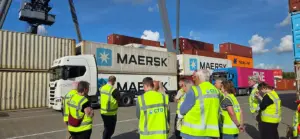
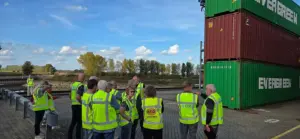
On Friday 2 October, we welcomed 16 members of the Doesburg municipal council for a working visit to our terminal. There was plenty of positive input, and the council’s involvement was clearly felt.
After an introduction, the council members were given a tour of the terminal. We then answered their questions and showed what our terminal means for Doesburg, for the region and for connecting local businesses to the global economy.
In short
Container Terminal Doesburg (CTD) connects businesses in the Achterhoek, Liemers and Stedendriehoek regions with the port of Rotterdam every day via inland shipping. During the working visit of the Doesburg municipal council, the central question was how the municipality and the business community can jointly strengthen transport by water. After all, investing in inland waterway infrastructure can contribute to accessibility, sustainability and economic growth in the region.
The logistics link between the region and the world’s ports
A container terminal plays an important role in the logistical accessibility of the Achterhoek, Liemers and Stedendriehoek. Every day, we connect businesses in the region with the seaport of Rotterdam, and from there with the rest of the world.
We transport containers by water via inland shipping as much as possible. As a result, there are fewer trucks on the road, we reduce CO₂ emissions and the region remains more accessible. Read more about the trade-off between road and water in Transport by water: a better alternative to road transport?
Duurzaam groeien doen we samen
For us, sustainability is about more than inland shipping alone. Within our operations, we continuously invest in:
- more efficient processes;
- digital solutions;
- further reduction of emissions;
- making optimal use of existing infrastructure.
A strong logistics infrastructure is also a precondition for businesses to settle, invest and grow in the region. That kind of sustainable growth is only possible when business and government jointly invest in accessibility, space for logistics and a robust infrastructure for the future. Our mission: to keep the Liemers and Achterhoek sustainably connected to the world’s ports, so that economic development and quality of life continue to strengthen each other.
“Investing in inland waterway infrastructure is not a cost item, but an investment in accessibility, sustainability and economic growth.” Remco Römer, Branch Manager Container Terminal Doesburg
The question we left with the municipality
Transport by water demonstrably contributes to lower emissions, less traffic congestion and a stronger regional economy. So what can the municipality and the business community do together to further strengthen this mode of transport? We are keen to continue that conversation.
Curious what transport by water could mean for your container flows? Also read Multimodal transport in practice or contact us.
Frequently Asked Questions
What does Container Terminal Doesburg do for the region?
Container Terminal Doesburg (CTD) connects businesses in the Achterhoek, Liemers and Stedendriehoek with the seaport of Rotterdam and the rest of the world. Containers travel by inland vessel between Rotterdam and Doesburg as much as possible. In this way, CTD contributes to the accessibility and economic development of the region.
Why is transport by water good for the region’s accessibility?
Every container transported by ship does not need to travel by road to Rotterdam. That means fewer trucks on the road, less traffic congestion and lower CO₂ emissions.
Why did the Doesburg municipal council visit CTD?
On 2 October 2026, 16 members of the Doesburg municipal council paid a working visit to the terminal. The visit provided insight into CTD’s role in the logistics chain and into the opportunities to further strengthen transport by water together with the municipality.
How can the municipality and the business community strengthen inland shipping?
According to CTD, sustainable growth requires joint investment in accessibility, space for logistics and a robust infrastructure. CTD therefore sees investing in inland waterway infrastructure as an investment in accessibility, sustainability and economic growth.